Scheduling
How to Schedule a Week of Yoga Classes Without Burning Out
A practical scheduling framework for solo yoga teachers — recurring classes, private sessions, and the quiet hours that have to stay quiet.
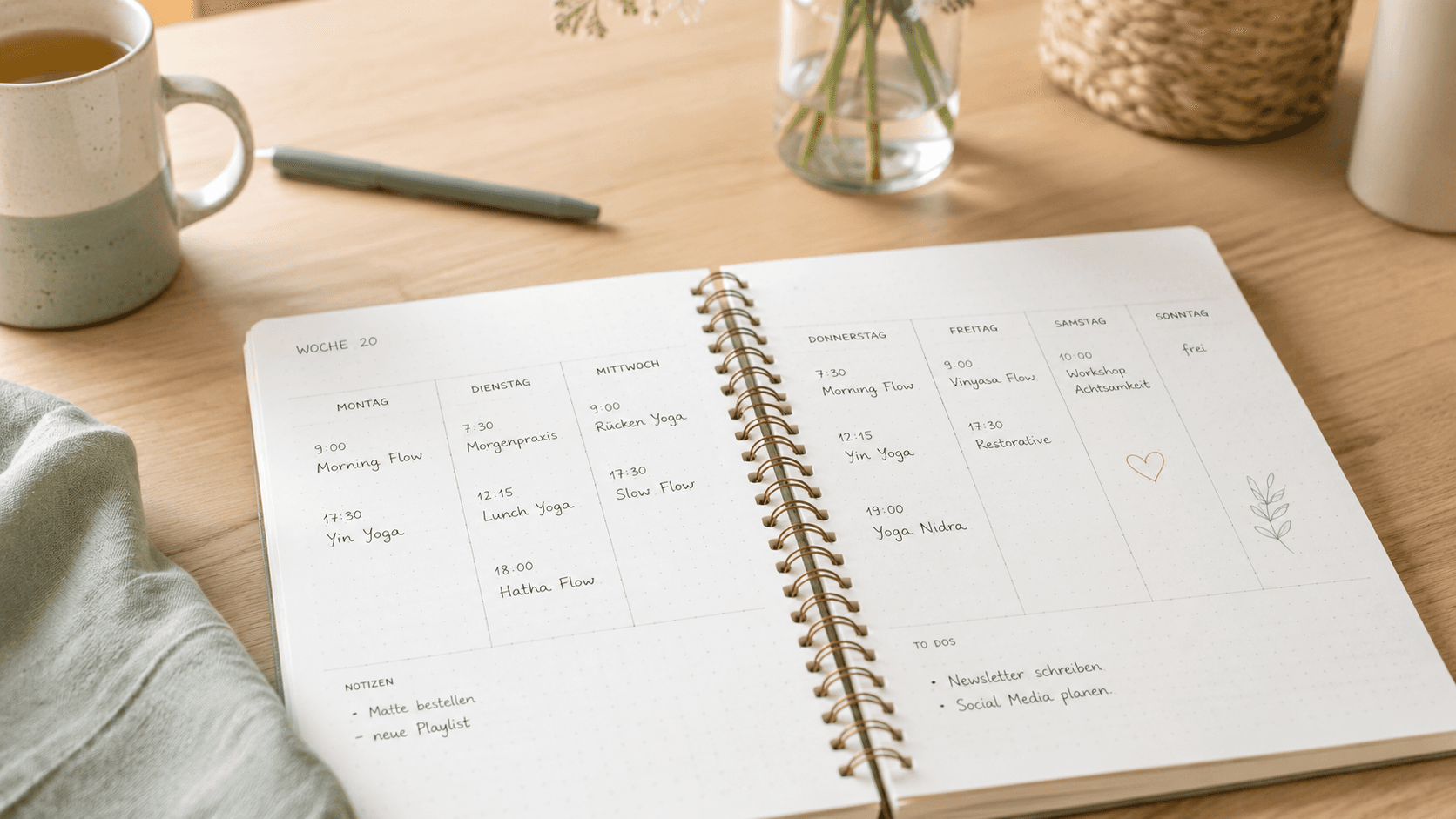
There is a moment, usually around the second year of teaching, when a yoga teacher's week stops fitting on a sticky note. The first studio added a Saturday. A regular private student asks to move to mornings. A second studio offers Tuesday evenings if you can also cover the occasional cover slot. Suddenly the calendar is the job, and the practice has to compete with it.
This post is about putting the calendar back in its place. We will talk about the difference between recurring and one-off events, why a "studio" view and a "client" view both matter, how to protect your own practice and rest, and how to make the messy edge cases — a student who pays by class, a studio that cancels at short notice, a workshop you only run twice a year — feel ordinary instead of stressful.
Start by drawing your week, not your year
A common mistake is to plan a yoga schedule like a corporate calendar — quarter goals, annual targets, big blocks. A teaching week is not that. The same shape repeats every seven days, with occasional ripples. Plan the shape first.
Sit down with a blank week (paper is fine; a tool is fine too) and mark, in order:
- Your own practice. Two or three slots, non-negotiable. If you do not block them now, you will lose them within a month.
- Your studio classes. These are usually fixed by the studio and recur every week.
- Your private students who pay for a slot, not a class. People who pay you for "Wednesday at 7" rather than for individual sessions get priority over flexible bookings.
- Flexible private students and workshops. Booked into the remaining space.
- Admin. Two short blocks a week, ideally far from teaching.
- Buffer. At least one full half-day that is empty.
The order matters. If you skip step one, every subsequent step quietly eats the slot you should have been practising in.
Recurring events are the backbone
Most of a yoga teacher's calendar is recurring. The same Studio Lila Vinyasa class on Wednesdays at 7. The same private student on Tuesday mornings. A good calendar tool should let you set the rule once and stop thinking about it.
What "set the rule once" should mean, concretely:
- Pick the start time, duration, and recurrence (weekly, every two weeks, monthly).
- Set the location once.
- Assign the studio or client once.
- Note the per-event income or expense once, and let the totals flow through.
If you find yourself copying-and-pasting class details from week to week, the tool is fighting you. Inside Yogarium, recurring events expand automatically on the calendar and feed straight into the finance view, so you never need to re-enter Wednesday at 7 the way you re-entered it last week.
Five kinds of event, five different rules
I now categorise events into five types, and each one behaves differently:
Studio classes. Set by the studio. You are paid per class or per month. Cancellation policy is whatever the studio writes. These are the most "fixed" parts of your week.
Private sessions. Set by you and one client. You set the price, the cancellation policy, the location. These are also where the most communication lives — moves, reschedules, no-shows.
Your own learning and training. A teacher training, a workshop you are taking, a continuing-education course. Treat these like studio classes: they are non-negotiable once booked.
Your own practice. Self-led time on your mat or at someone else's class. Block them like clients.
Personal time. Doctor, family, travel. Visible on the calendar even if no one else sees them, so you do not double-book yourself.
Yogarium uses exactly these five categories so the calendar colour-codes them at a glance. The reason is not aesthetics. It is so a glance can answer the question that matters: "do I have space here?"
The studio view and the client view
A second mental model that helps is to look at the same week through two different lenses:
The studio view answers: how much am I teaching at each studio, and what does that earn? Useful for renegotiating rates or deciding to drop a slot.
The client view answers: how often am I seeing each private student, when did I last see them, and what is their balance? Useful for follow-up, for retention, and for catching the slow drift of a student who stopped booking.
Most calendar tools only show the time view, which is fine for "what do I have today" but useless for the other two questions. Tooling that links events to studios and to clients, and surfaces both views, is what turns a calendar into a small business dashboard. Yogarium ships this by default: every event can be tagged with a studio (with a colour) and one or more clients, and the client profile shows their entire history at a glance.
Protecting your own practice
I will repeat this point because it is the one most often skipped: block your own practice in the calendar like a paying student.
A teacher who does not practise erodes within months. A teacher whose practice slot is conditional on "if nothing else comes up" erodes within weeks. Block the slot, give it a recurring rule, and treat any conflict as a real conflict — not as a flexible default to override.
If you teach evenings, your practice probably has to be in the morning. If you teach mornings, your practice probably has to be in the late afternoon. Find the slot, lock it, do not negotiate with yourself about it.
Cancellations and reschedules
The most painful part of scheduling is not building the week. It is the messy middle: a student who cancels two hours before, a studio whose class is moved by a day, a workshop that has to move because of a venue conflict.
A few rules that help:
- Have a written cancellation policy for private sessions. "24 hours' notice or the session is charged." Send it once, in the welcome message, then never argue about it. Yogarium lets you put this on the auto-confirmation email and the public booking page so students see it before they book.
- Use a single source of truth. If a student texts you to reschedule, move the event in your calendar before you reply. Confirming a new time only in messages is how double-bookings happen.
- Treat studio cancellations as data. If a studio cancels last-minute three times in two months, that is a pattern. Either renegotiate the slot or drop it. You are not obliged to keep a slot that is unreliable.
Workshops, retreats, and the once-a-quarter events
The events that bite are not the weekly classes. They are the ones that happen rarely enough that you have to rebuild the process each time: a Saturday workshop, a weekend immersion, a teacher-training contribution.
These need a tiny project plan, not just a calendar event:
- A booking page that takes signups (the same as a regular class, just with a higher cap).
- An auto-confirmation email that contains the venue, the time, what to bring.
- A reminder email the day before.
- An invoice — either issued at booking, or at the door.
Inside Yogarium, you can attach a public booking page to any event, including one-off workshops, so this entire flow is the same as a Wednesday evening class. The teacher experience is identical. The student experience scales.
The five-minute weekly review
End the week with a five-minute review. Open the calendar. For each event:
- Mark attendance.
- Note expenses (the train ticket to the studio, the supplement you bought for class).
- If a private session was a no-show, decide now whether to charge.
Then look ahead one week. Anything missing? Anyone overdue for a check-in? Any new student to onboard?
Five minutes. Once a week. This is the single highest-leverage habit I know of for a teaching business.
Common questions
How many classes a week is too many?
There is no universal number, but a teacher who is doing more than fifteen contact hours a week (teaching plus private sessions) without rest days will struggle to sustain it for more than a year. Two days off in a row, every week, is a strong baseline.
Should I teach back-to-back classes at different studios?
If you can; just make sure your travel time is realistic and block it in the calendar as a real event. A class that runs late plus traffic plus a forgotten phone charger is enough to make you fifteen minutes late to studio two, and that costs trust.
How do I handle a recurring student who stops showing up?
Block one of the next two sessions, then reach out. Most disappearances are temporary and have a real reason. A short, warm "I noticed you missed the last two — is everything okay?" message usually re-engages them or surfaces a clean reason to release the slot.
Should I use one calendar or separate calendars for studios and private students?
One. Always one. Separate calendars is how you double-book yourself.
The week is not the year, and the year is not the practice. Once the week has a shape, the year mostly takes care of itself, and the practice has room to stay alive.
If you would like the calendar and the client view and the invoice flow to live in one tool — for free, with no ads and no marketplace — Yogarium is here.
Try it free
Run the business side of your practice with Yogarium.
Scheduling, invoicing, client notes and a calm booking portal — all in one tool, designed for solo yoga teachers. No credit card required.
Start for freeLast updated
Auf Deutsch lesen